
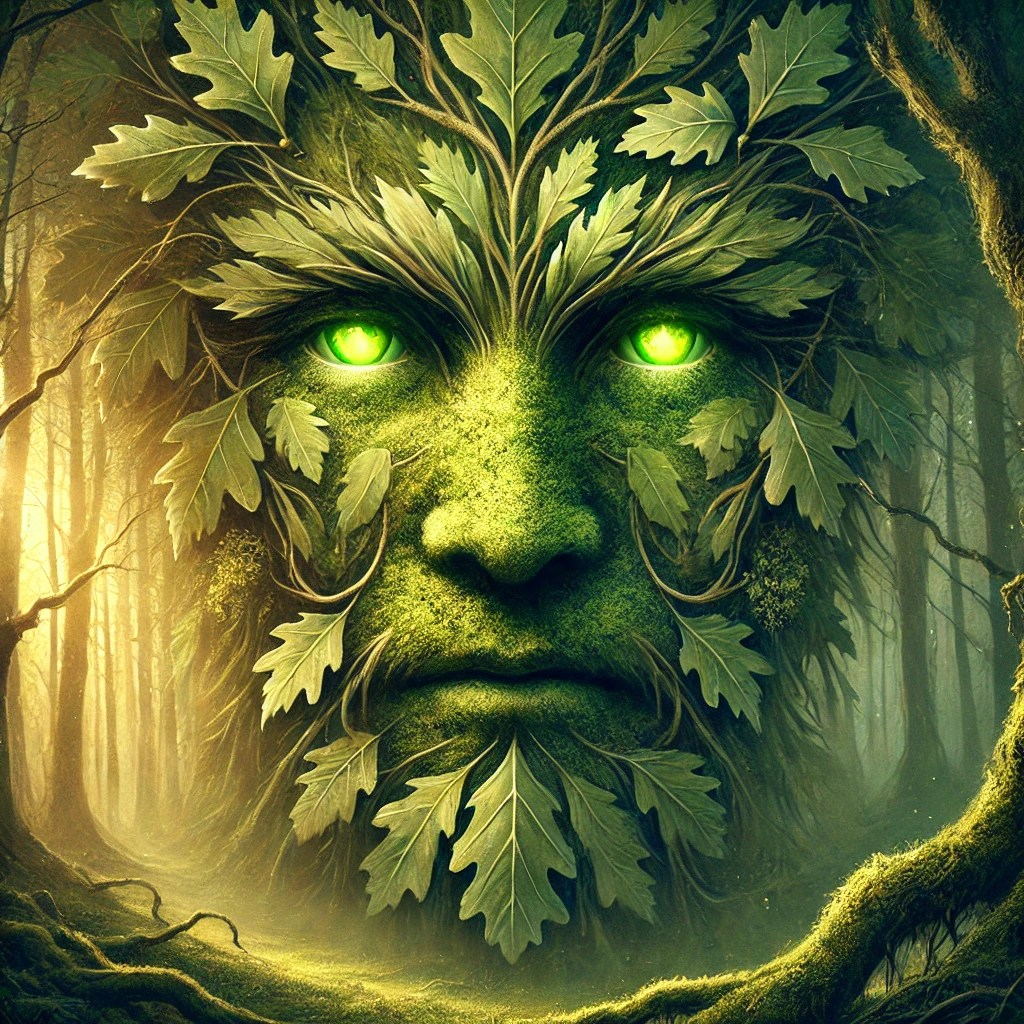
Deep within ancient forests and hidden among the ruins of old temples, a mysterious figure watches over the land—The Green Man. His face, woven from twisting vines and oak leaves, has adorned churches, manuscripts, and stone carvings for centuries. But who is he?
The Green Man is a symbol of nature’s cycles, renewal, and the eternal connection between humanity and the wild. Found in cultures across Europe and beyond, he embodies the changing of the seasons, the rebirth of spring, and the untamed spirit of the earth.
Origins & Symbolism
Though often linked to Celtic folklore and pagan traditions, the Green Man’s roots stretch deep into history. Some trace his presence to Roman and Mesopotamian carvings, while others see connections to Dionysus, Cernunnos, or even Osiris—all deities tied to nature, fertility, and transformation.
His many forms include:
The Foliate Head – A face made entirely of leaves.
The Disgorging Green Man – A mouth expelling vines and foliage, symbolising growth and rebirth.
The Bloodsucker Head – A darker version where plants emerge from his face like a warning of nature reclaiming all things.
Seen in medieval churches, the Green Man often appears alongside Christian imagery—perhaps a lingering echo of older, pre-Christian beliefs.
The Green Man in Myth & Modern Paganism
In modern Paganism and Druidic traditions, the Green Man is revered as a guardian of the land. He represents:
The cycle of life, death, and rebirth—dying in autumn, reborn in spring.
A wild, untamed force, reminding us of the raw power of nature.
The balance between humanity and the earth, urging us to respect and protect the land.
He is often linked to Beltane and Samhain, the festivals of fertility and the thinning of the veil. Some also associate him with Herne the Hunter, a spectral figure of English folklore who roams the forests.
The Green Man Today
The Green Man endures as a powerful symbol of ecological awareness. Many see him as a call to reconnect with nature, to honour the forests, and to embrace the wisdom of the land. His face appears on pub signs, garden sculptures, and modern Pagan altars—watching, reminding, and whispering through the rustling leaves.
As spring approaches, we honour the Green Man’s return. The bare trees will soon be cloaked in green, the earth will stir, and new life will emerge once more.
 Handcrafted Jewellery Inspired by Scottish Folklore and Nature | Rock & Ore